
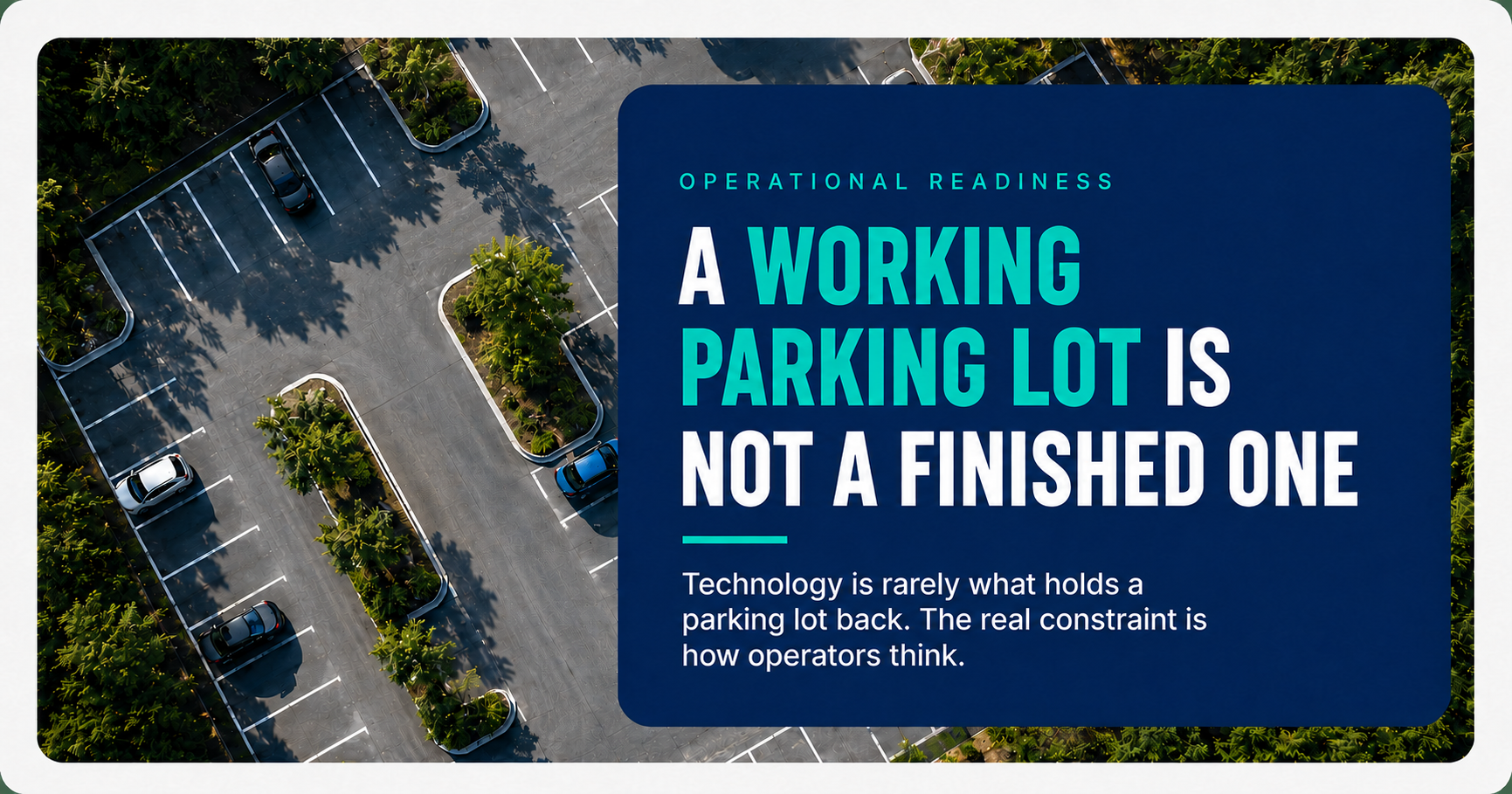
Our Chief Technology Officer Sean Glavin brought nine years of Army experience, six of them with 5th Special Forces Group, into a new piece for IPMI's Parking & Mobility magazine. His argument is simple and a little uncomfortable. Most underperforming lots are not held back by technology. They are held back by thinking.
Read the full article here: Always Improve Your Foxhole: A Green Beret's Approach to Running Lots
The Idea Behind the Title
Soldiers taking a new position dig a shallow foxhole first, because that is all the time allows. Then, the moment there is a lull, they dig deeper and add cover. Nobody stands up and declares the foxhole finished.
Sean's point is that parking lots get treated the opposite way. An owner picks a rate, installs the signs, hires an enforcement vendor, and then leaves the whole arrangement alone for years. Nothing is broken. Revenue comes in. There is no fire to put out.
That is exactly the problem. Parking is one of the most dynamic assets in commercial real estate. Demand moves by the hour. Weather, events, seasonality, and nearby development reshape what a space is worth from one week to the next. A lot priced correctly in 2022 is almost certainly mispriced today.
A working system and an optimized one are not the same thing. The gap between them is revenue leaving quietly, without anyone noticing it go.
Deciding Is Not the Same as Changing
This is the part of the article we keep coming back to internally.
A decision is internal. It happens in a meeting, on a call, or in your own head. You resolve to raise the daily rate, replace the vendor, or add cameras. It feels like progress because something open is now settled.
A change is external. The new rate goes live. The new vendor takes over. The camera actually records.
The market never responds to your decisions. It responds only to your changes. Plenty of owners get stranded in the decision phase, waiting for a cleaner picture before they move, and the waiting itself becomes a choice. Usually the wrong one, made by default.
Small Moves Compound
Sean shares a lot where the team raised a $5 monthly pass by 25 cents. Then did it again the following year. And again the year after that. Three years later, pass sales had not dipped once, and the lot was producing roughly 5 percent more revenue annually from a change that cost nothing but the willingness to make it and the discipline to measure the result.
The revenue mattered. The information mattered more. That lot could carry more than anyone had assumed. Turning on dynamic pricing captured another $2 per pass during near-full periods, with no drop in volume.
None of it was dramatic. That is the entire point. Compounding is what turns modest, repeated adjustments into a materially more valuable asset, and it is why HAH Parking partners average a 30 to 40 percent revenue lift without adding a single space.
Where Technology Fits
One lot is manageable by instinct. An owner can hold the whole picture in their head and feel the moment something drifts.
Fifty lots break that. Too many variables, too much noise, not enough hours. As Sean puts it, technology is not a substitute for judgment. It is what lets judgment keep working after the problem outgrows one person's attention.
That is the standard we built XPRK against. XControl puts revenue, occupancy, pricing, and compliance data in front of an owner in real time, while a decision is still live rather than months after the fact. XPay removes payment friction so volume is not lost at the point of transaction. XForce handles compliance in the background, with reminders that resolve most issues before they become violations.
The tools are only worth having because they shorten the distance between noticing something and acting on it.
The Takeaway for Owners
The operators pulling away from the field are rarely the ones with the largest budgets or the newest equipment. They are the ones who treat a parking lot as a living business rather than a fixed asset. They decide, then they actually change something, then they measure what happened.
If your rates have not moved in two years, that is not stability. It is a position you dug once and never came back to.
Read Sean's full article in Parking & Mobility
Sean Glavin is Chief Technology Officer at HAH Parking. His article "Always Improve Your Foxhole" appeared as an online exclusive in IPMI's Parking & Mobility magazine in August 2026.