
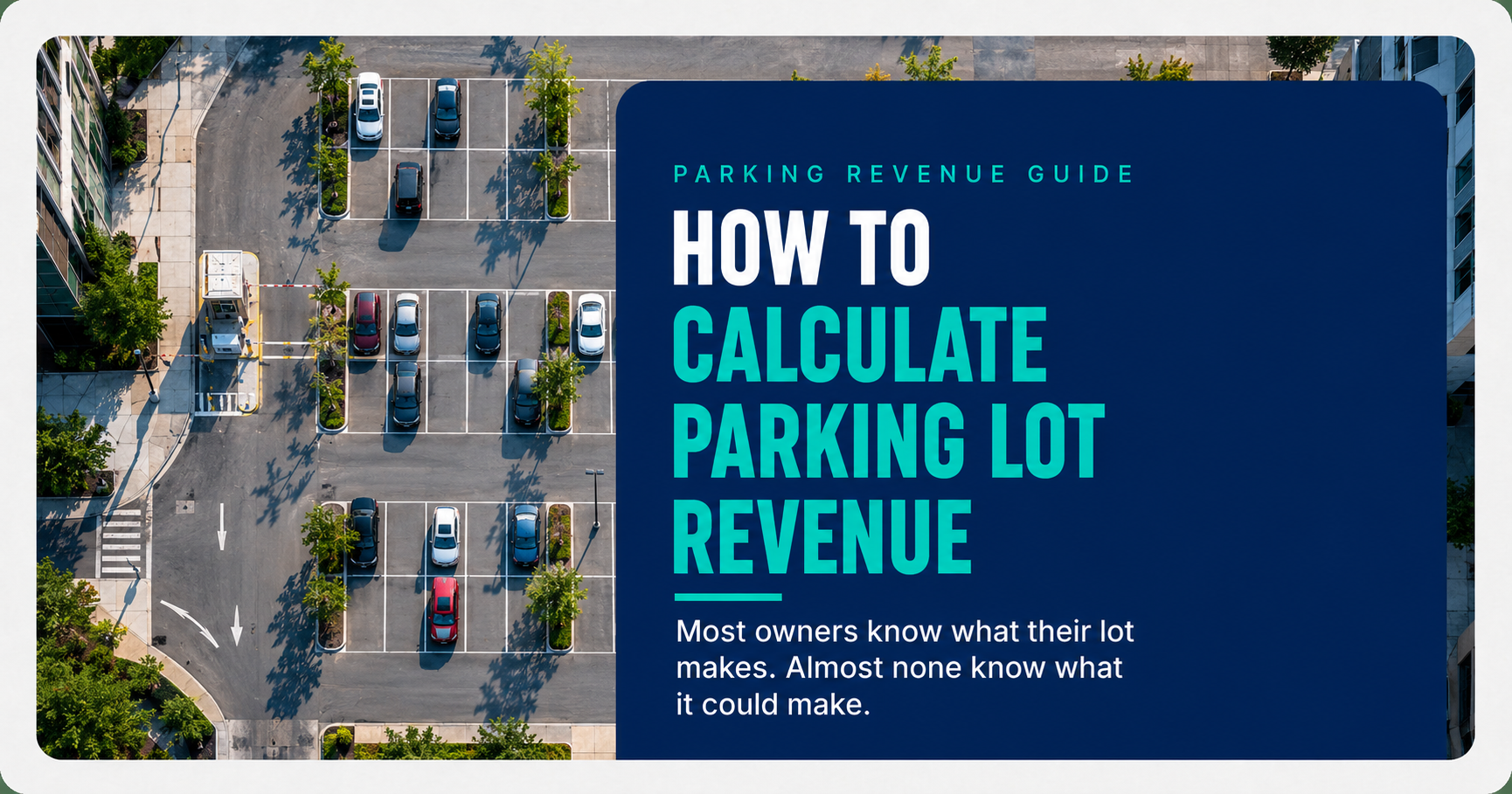
Ask a parking lot owner what the lot makes and you get a confident answer, usually to the dollar. Ask what it could make and the answer gets vague fast.
That is not a knock on anyone. The first number shows up on a bank statement every month. The second one requires you to imagine the same asphalt, the same space count, and the same drivers under a pricing model you have never run. There is nothing to compare against, so most owners assume the current number is the real number and move on to the next property.
The gap between those two numbers is rarely small. A 50 space lot at 45 percent occupancy charging $3.00 an hour brings in about $3,645 a month. Move that same lot to pricing that tracks demand instead of sitting still, and it produces closer to $4,884. That is $14,872 a year on a small lot, with no new spaces, no construction, no added staff, and no change to the property at all.
Scale it to 150 spaces and the annual gap clears $96,000.
This is why we built the Parking Revenue Upside Calculator. It shows both numbers side by side in about a minute. But before you trust any calculator, it helps to know what it is actually doing, because the inputs are where owners get it wrong.
The Parking Lot Revenue Formula
To calculate parking lot revenue, multiply your number of spaces by your average occupancy rate, then by average parking duration in hours, then by your hourly rate, then by chargeable days per month.
Monthly revenue = spaces x occupancy x duration x hourly rate x chargeable days
Multiply by 12 for the year.
The thing worth sitting with is that you are not selling parking spaces. You are selling paid hours. Two identical lots across the street from each other can be $200,000 a year apart because one of them sells more hours than the other, at a better rate, more often.
The Inputs Owners Get Wrong
Five numbers go into the formula. In practice, three of them are usually guesses.
Usable Spaces, Not Striped Spaces
Count what a paying driver can actually park in today. Subtract tenant spaces, reserved spaces, and anything blocked by a dumpster or a loading zone. A 200 space site plan with 34 spaces promised to tenants is a 166 space revenue asset.
Occupancy, Averaged Across the Whole Week
Owners picture Friday at 7pm. Tuesday at 10am belongs in the same average. If you have no data, start low. A surface lot in a secondary market at 40 to 50 percent is normal, and anything holding above 70 percent all week usually means the rate is too low.
Average Parking Duration
This is the input almost nobody tracks, and it moves revenue exactly as hard as price does. Two hours at $3.00 is six dollars. One hour at $3.00 is three. Same space, same rate, half the money.
If you are guessing at duration, you are guessing at half your revenue.
Your Effective Hourly Rate
Divide what you collected by the paid hours you sold. Validations, early exits, comps, monthly permits, and unpaid sessions all drag the real number below the sign on the wall. A lot posting $4.00 an hour often runs closer to $2.60 in practice.
Chargeable Days
Not every lot charges 30 days a month. Seasonal lots, event lots, and office lots that only monetize after business hours have far fewer. Use the days you actually charge, not the days on the calendar.
Working Through a Real Lot
Take a 150 space downtown surface lot. Occupancy runs 60 percent across the week, drivers stay an average of 2.5 hours, the effective rate is $3.50 an hour, and the lot charges all 30 days.
That works out to $23,625 a month, or $283,500 a year. About $157 per space per month.
Now hold every one of those inputs still and change only the pricing model. At the 34 percent average lift HAH Parking partners see after moving to dynamic pricing, the same lot produces $31,658 a month and $379,890 a year. The difference is $96,390, and it arrives without adding a single space.
Here is the part that matters to anyone who thinks about the property as an asset rather than a line item. Almost none of that $96,390 gets eaten by expenses. Your taxes, insurance, lighting, and striping do not go up because your average rate went up. The gain lands on the bottom line nearly intact, and at a 7 percent cap rate every $10,000 of net operating income adds about $143,000 in value. The revenue story and the valuation story are the same story.
Why the Real Upside Is Often Bigger Than 34 Percent
Averages hide the interesting cases. Three HAH Parking partner locations moved from static pricing to demand based pricing, and the results looked nothing alike.
The first lot went from $100,500 a year to $168,400, a gain of $67,900, while transactions actually fell 18 percent. The average ticket more than doubled, from $4.03 to $8.19. The second went from $389,600 to $489,400 with transaction volume essentially flat. The third, a much smaller lot, went from $10,645 to $26,000 with transactions up 40 percent.
Look at the first one again. Fewer cars came through the lot and revenue still rose $67,900. If the only thing that lot tracked was cars in and out, the year would have read as a decline.
A full lot is not the goal. A full lot at the wrong price is a pricing problem in a success costume.
Run Your Own Numbers
Enter your five inputs in the Parking Revenue Upside Calculator and you will see your monthly and annual revenue as it stands today next to what the same lot could produce under dynamic pricing. There is a slider on the uplift if you want to model something more conservative than the 34 percent average and give yourself a floor instead of a midpoint.
When you ask for the full breakdown, you also get the Parking Revenue Kit:
- The Simple Parking Optimization Playbook, the framework behind the two levers that actually move parking revenue.
- The Simple Parking Optimization Checklist, which you can run on your own lot this week.
- The Dynamic Pricing Case Study, with the complete before and after numbers.
- HAH Parking case studies across different lot types and markets.
No cost, no obligation, and nothing you have to install to find out. If you would rather talk it through than read four documents, there is an option on the same page to book a call.