
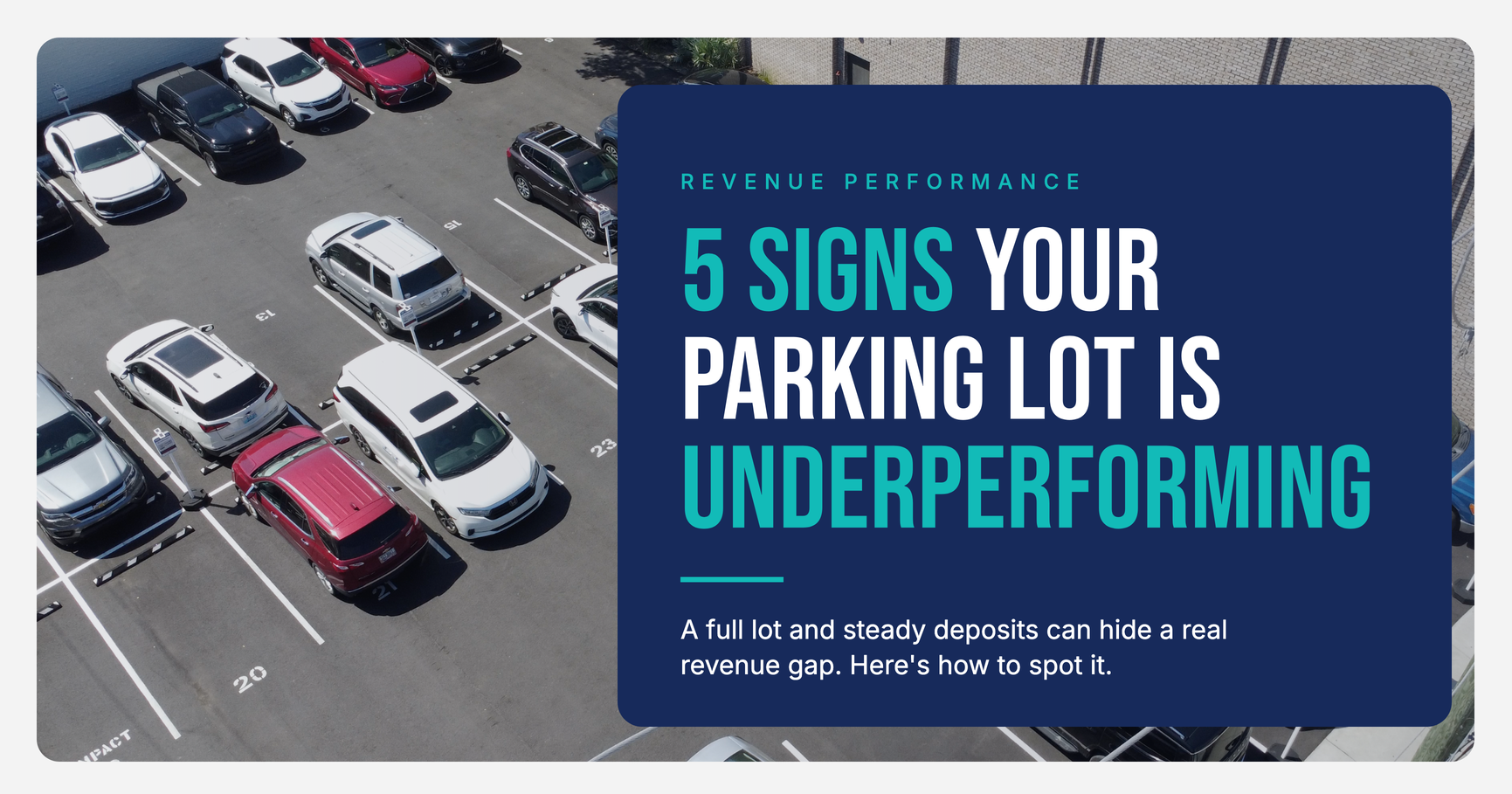
An underperforming parking lot earns less than it should, even if it's making money. The five most common signs are rates that haven't changed in a year, a lot that fills early and stays full, revenue you only see at month-end, drivers who skip paying, and a lot that looks worn down.
Key Takeaways
- A lot that's full by noon is usually underpriced for those hours, not maxed out.
- Pricing to demand has raised revenue 30% to 40% on average across the lots where we've turned it on.
- Easy payment does more for compliance than enforcement does.
- Curb appeal upgrades have lifted revenue per space 20% to 30%.
Your lot makes money. Cars pull in, drivers pay, and deposits show up. So it feels like it's working.
But making money and earning what it should aren't the same thing. Most lot owners have no baseline to compare against. They don't know what a well-run lot their size, in their location, brings in. So a flat month looks normal.
We work on real lots every day, and we see the same five signs again and again. If two or three of these sound familiar, your lot is probably leaving money on the table.
Sign 1: Your Rates Haven't Changed in Over a Year
If your rates haven't changed in over a year, they're probably lower than what drivers will pay today. Think back to your last price change. If you can't remember it, that's the first sign.
Demand around your lot shifts all the time. New restaurants open. Offices fill back up. Events get booked. A rate you set two years ago doesn't know any of that. It charges the same on a quiet Tuesday morning as it does on a packed Saturday night.
The first fix is simple: get your base rate right. That's the starting price your lot charges before anything else kicks in. Many lots are priced from habit, not from what drivers will pay today.
Fixing a stale rate can move the number fast. Allan, a parking operator in Virginia, ran his lots the old way for decades: cash boxes, staff on site, and little room to change prices. After we upgraded his lot and started pricing it to demand, his average pass value went from $8 to $15.
Sign 2: Your Lot Fills Up and Stays Full
A lot that fills up early and stays full is usually priced too low for those hours. A full lot feels like a win. Most of the time, it isn't.
If every space is gone by noon, drivers would have paid more. And the ones who show up at one o'clock and find no space just drive on to the next lot.
Flat rates don't usually hurt you on slow days, because your base rate is your floor. The real cost shows up on busy days, when demand is high and your price stays put.
That's where automated, demand-based pricing comes in. You may have heard it called dynamic pricing. Rates rise as the lot fills and ease back as demand drops, all within limits you set ahead of time. Nobody has to swap a sign or call a vendor.
Here's what that looked like on one lot we manage. Revenue per transaction, meaning what the lot earns from each parking session, more than doubled, from $4.03 to $8.19. The lot saw 18% fewer transactions, and total revenue still grew by about 68%. Across the lots where we've turned on demand-based pricing, we've seen 30% to 40% more revenue on average.
"Most owners think a full lot means they priced it right. Usually it means they priced it too low. Once rates move with demand, your busiest hours finally earn what they're worth."
Sean Glavin, Chief Technology Officer, HAH Parking
Sign 3: You Find Out What You Earned at the End of the Month
If you only see your revenue in a monthly report, you can't spot problems or tell whether a price change worked. Quick test: what did your lot earn last Tuesday between 5 p.m. and 9 p.m.?
If you'd have to wait for a report, or dig through a cash box and a spreadsheet, you can't see which hours are busy, which days are slow, or what's going wrong while it's happening.
Cash adds its own costs. Someone has to collect it, count it, and match it to the books. Every handoff is a chance for money to go missing.
A real-time parking dashboard shows revenue, transactions, and occupancy as they happen. Occupancy is simply how full your lot is at a given moment. Once you can see it, you can price it.
Sign 4: Drivers Park Without Paying
When drivers park without paying, it's usually because paying is too hard, not because they're trying to get away with something. Many just hit a wall. The kiosk is down. The sign is confusing. The payment page wants an account and a password. So they give up and walk off.
Every extra step between a driver and payment costs you money. The fix is to remove the steps.
With text-to-pay parking, drivers scan a code or send a text, enter their plate, time, and card, and they're done. No download, no login. We also text drivers 15 minutes before their pass runs out and again when it expires. Many of them simply extend their stay.
This is what we mean by compliance: the share of drivers who pay for the time they use. Clear signs and easy payment do most of the work. Enforcement tools still have a place, but they work best as a backstop, not the main plan.
Sign 5: Your Lot Looks Like an Afterthought
A worn-down lot lowers what drivers are willing to pay, and some will skip it entirely. Drivers size up a lot in a few seconds. Faded lines, potholes, and a dark corner at night all say "this place isn't worth much."
Curb appeal is a real revenue lever, and one of the three pillars in our Simple Parking Optimization Playbook. Fresh striping, patched pavement, and well-lit signs make a lot feel safe and professional, and that supports a higher price. On lots where we've coordinated these upgrades, we've seen revenue per space rise 20% to 30%.
Upgrades are optional and cost extra, so they only make sense when the lot needs them. In our experience, the added revenue has covered the cost of the work.
The 5 Signs at a Glance
| Sign | What it costs you | The fix |
|---|---|---|
| Rates unchanged for a year | Underpriced at every hour | Reset your base rate |
| Full by noon | Lost peak revenue and drivers turned away | Demand-based pricing |
| Month-end-only numbers | You can't spot problems or test prices | A real-time dashboard |
| Drivers not paying | Revenue leakage | Text-to-pay, expiry reminders, and enforcement as a backstop |
| Worn-down lot | Drivers willing to pay less | Striping, paving, and lighting |
How Do You Fix an Underperforming Parking Lot?
Start by measuring where you are, fix the low-cost problems first, and then let pricing follow demand. Here's the order we use on our own lots.
Step 1: Start With Your Baseline
You can't close a gap you can't see. Pull together what you already know: your current rates, your busiest hours, and your monthly revenue. Our guide on how to calculate parking lot revenue walks through the math. Then compare it to what similar lots earn with demand-based pricing.
Step 2: Fix the Simple Things First
Clear signs, an easy way to pay, and a fresh base rate cost little and help right away. They raise both how many drivers pay and what each one pays.
Step 3: Let Pricing Follow Demand
Once the basics are in place, demand-based pricing does the ongoing work. Small gains on each transaction build on each other month after month. That's what we mean when we say parking revenue compounds.
If You Manage Lots for Other Owners
These five signs show up across whole portfolios, not just single lots. Fixing them on one lot gives you a result you can take to every client. And with white-label branding, your name stays on the signs, payment pages, and receipts.
See What Your Lot Could Earn
Curious how big the gap is on your lot? Our free revenue calculator gives you an estimate based on your lot's details. No signup needed.